Some good practices for the workflow
It is not a good idea to open pull requests from the master branch of your fork. (See this) This is mainly because all commits to
origin master, after opening the PR and before getting accepted, become a part of the pull request.Feature branches can be named
feature/*, bugfixes asbugfix/*and hotfixes ashotfix/*. This is purely optional, but it makes it easier for other developers to know what was done in the branch.The above convention might also come in handy when configuring automated docker builds for your repository. For e.g. docker image update branch names can be
docker/*and the appropriate regex can be configured in docker hub.Merging conventions
If you want to retain the commit history of the branch, then use the
fast forwardoption while merging:git merge --no-ff <branch>
Doing this helps in identifying the exact commits where the feature started and ended.
If the branch has a lot of silly commits (maybe you were trying to get travis to work), say something like this:
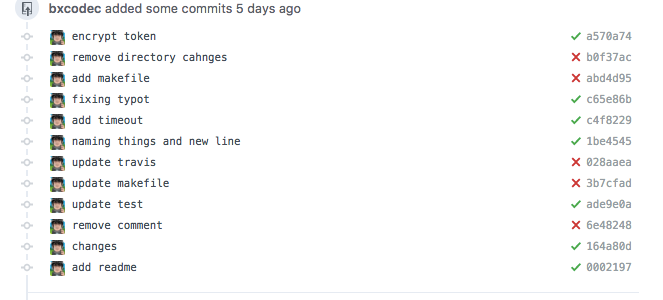
Surely, you wouldn’t want your clean git log to now show up these commits (these are terrible commit messages by the way). So the solution is to
Squash and Merge. If you’re doing it on the terminal, then:git checkout master git merge --squash <branch> git commit git push origin master
The third option is to just use
mergewhich fast-forwards commits by default. If done on the terminal:git checkout master git merge <branch> git commit git push origin master